Inspired & led by Swami Bodhananda SarasvatiWhatsApp Channel  ·  Sambodh USA
Home / Swami Bodhananda
Our Guru

Swami Bodhananda Sarasvati

A teacher of keen observation, sharp analysis, subtle perception and integral vision — marked by unconditional compassion.

Early life

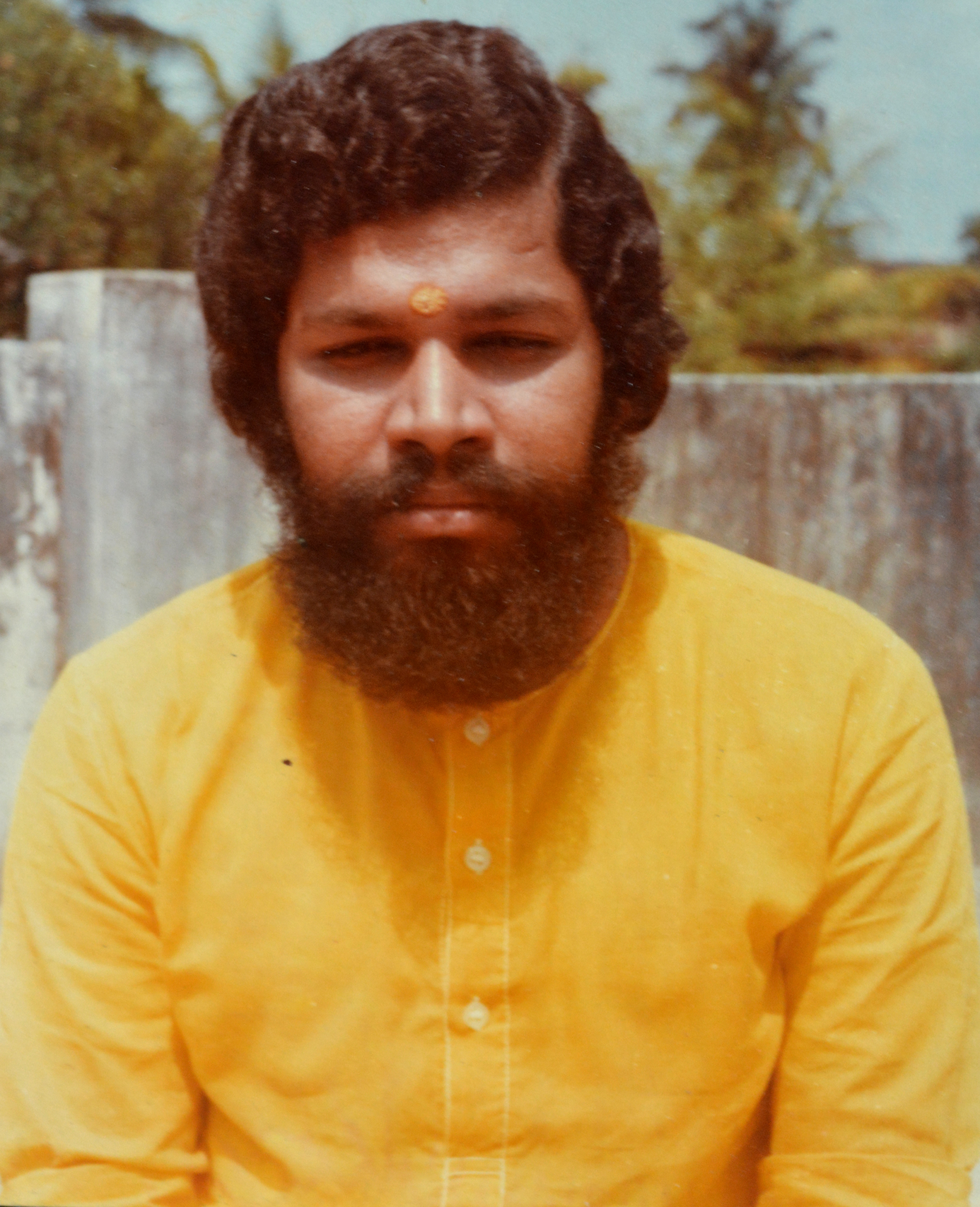
Swami Bodhananda as a young student

Swami Bodhananda was born in a quiet village called Mattatur, 36 miles north-east of Kalady in Kerala — the birthplace of Adi Sankaracharya. From early childhood he showed great interest in reading and discussing issues pertaining to his country, culture and geopolitics.

He spent long hours either in solitude or in dialogue with friends, teachers and wandering monks. The young mind was disinterested in the ordinary, and sought the Light that was beckoning him. He walked. He meditated. He kept silent. He read.

Every day the young boy walked ten miles to school, eager for classes and to devour books in the public library. By fourteen he had read Nehru's Glimpses of World History and the complete works of Swami Vivekananda and Mahatma Gandhi; by seventeen, Marx's Das Kapital, Adam Smith's The Wealth of Nations, Marcuse's One-Dimensional Man, Debray's Revolution in the Revolution and Camus' The Rebel.

A brilliant student, he graduated on a government scholarship from Christ College, Irinjalakuda, and chose economics and political science for post-graduation. Economics remained his favourite subject; his favourite teacher, Fr. Vivian, taught him economics.
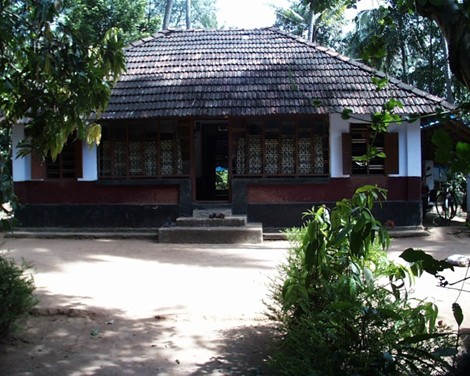
The ancestral home where Gurudev was born
Gurudev was born in this ancestral home
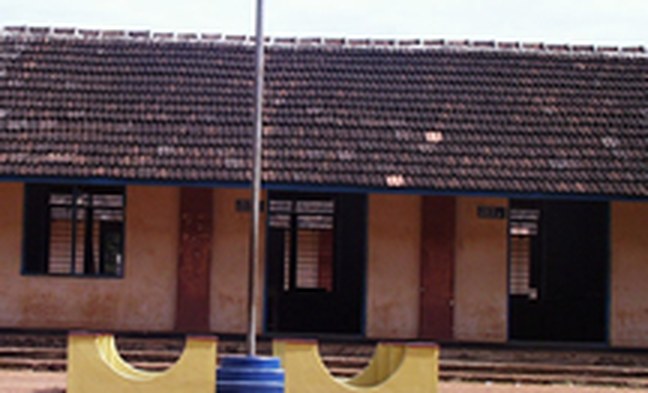
The Government school Gurudev attended
He went to this Government school
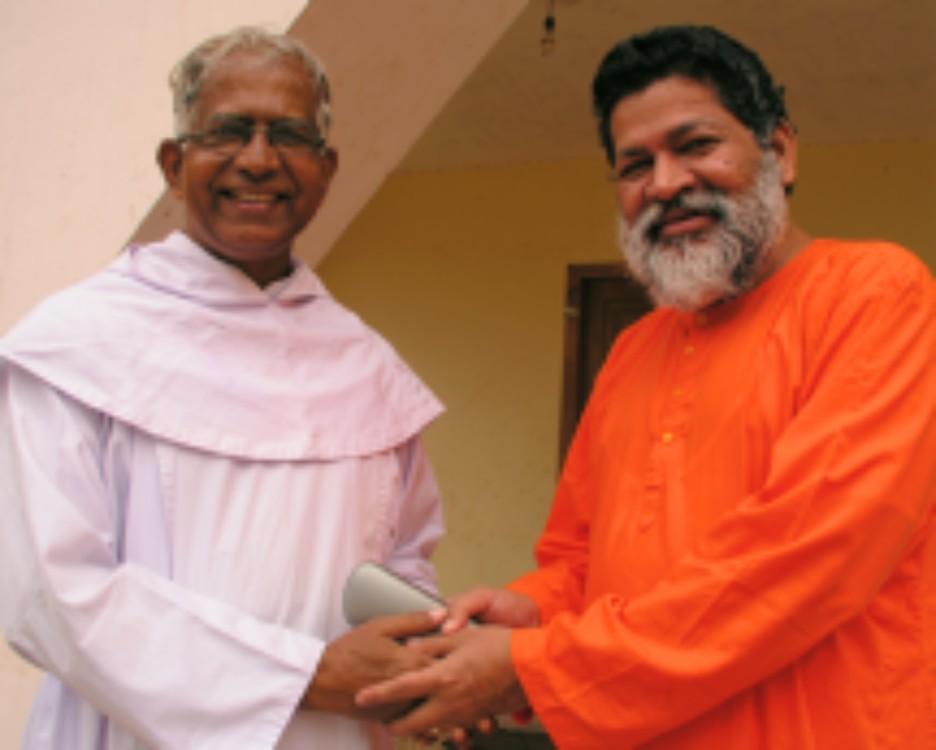
Swami Bodhananda with Father Vivian of Christ College
Father Vivian of Christ College, who taught him economics

In the Himalayas

Swami Bodhananda at Sidhbari, near Dharamshala

Gurudev spent several years in the Himalayas in silence, watching the embodiment of ultimate truth — the snow-clad mountains — and in meditation, absorbed in the non-dual basis of existence, Brahman.

His enlightenment is marked by compassion, love, and a crystal-clear vision that illumines even the darkest corners of the human mind.

Teacher of Vedanta
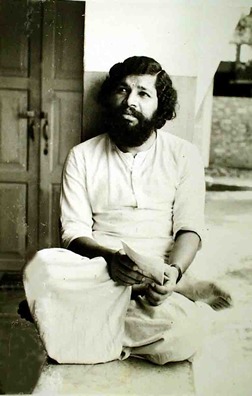
Swami Bodhananda seated on a doorstep, early eighties
In the early eighties

In the early eighties Swami Bodhananda spent several years teaching in Ernakulam, and his students at that time included very well-known community and social leaders of the day.

From 1987 to 1990 he was the Mukhyacharya at Sandeepany Sadhanalaya in Kasargode, north Kerala, inaugurated in September 1987, and taught a complete course of Vedanta to its first batch of Brahmacharis. The two-and-a-half-year course, with a syllabus to master the mind as well as the scriptures, produced many of today's well-known sannyasins — among them Swami Adhyatmananda, who now heads Sambodh Kerala.
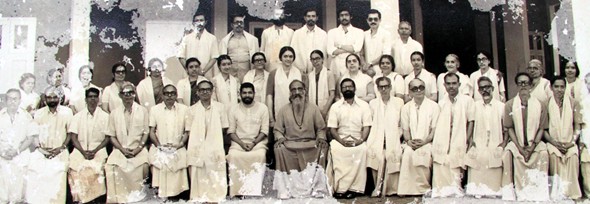
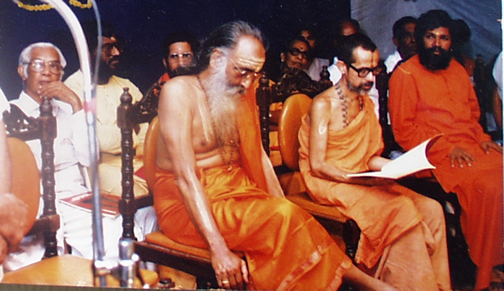
Swami Bodhananda with his students and Swami Chinmayananda at the completion of the Vedanta course, Ernakulam, early eighties
With his students at the completion of the Vedanta course, with Swami Chinmayananda — Ernakulam, early eighties
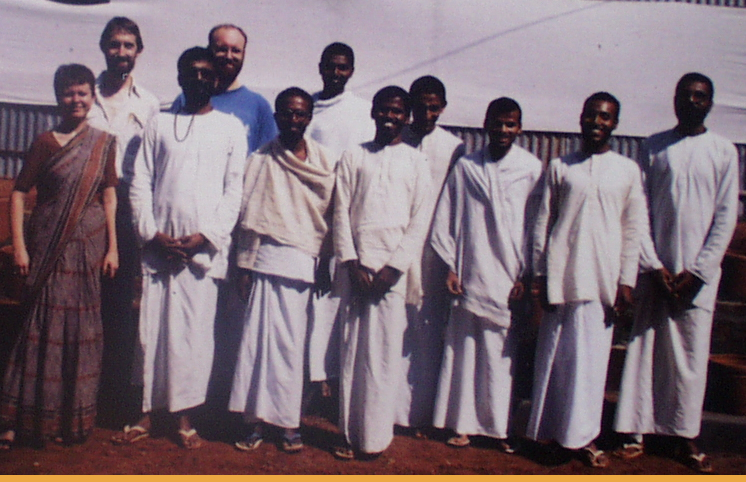
Inauguration of Sandeepany Sadhanalaya, Kasargode, 1987 Brahmacharis of the first batch, 1987 Swami Bodhananda with the Brahmacharis of Sandeepany Sadhanalaya, Kasargode Swami Bodhananda at Sandeepany Sadhanalaya, Kasargode
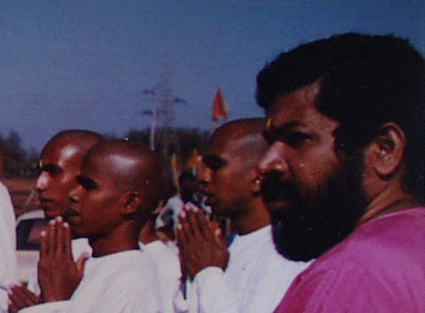
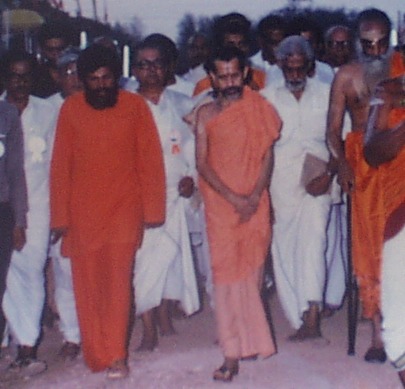
Swami Bodhananda walking with sannyasins and devotees
Gurudev (left) walking with sannyasins and devotees
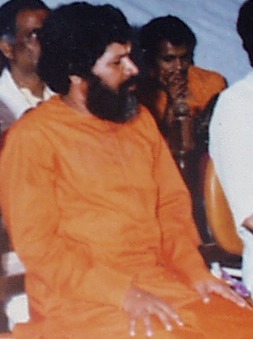
Swami Bodhananda seated at a gathering
Gurudev at a gathering

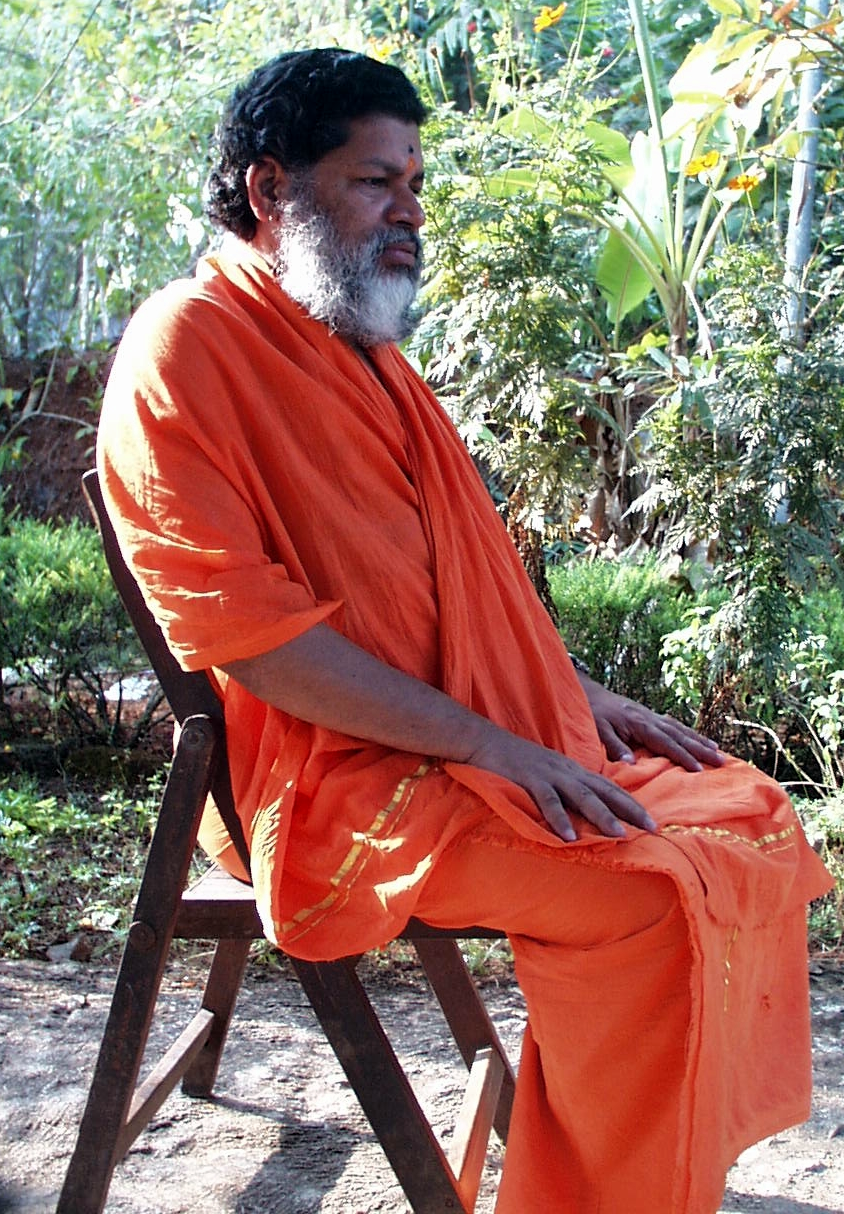
The teacher today

Swami Bodhananda in Calicut, 5 February 2003
Calicut, 5 February 2003

Swami Bodhananda is a teacher of keen observation, sharp analytical thinking, subtle perception and an integral vision, all marked by unconditional compassion for anyone and everyone who comes to him. Whether an issue is of geopolitical importance, philosophical abstraction or psychological complexity, his analysis brings nuanced clarity and a connected, unified presentation. Those who meet him find their question retold in an exhaustive, lucid and connected manner — and in that retelling, an enlightening response.

Gurudev believes in the fundamental unity of life, and in freedom of the individual as the uncompromisable value.
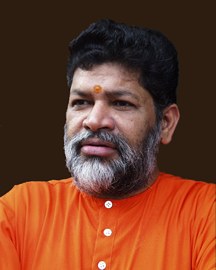
Portrait of Swami Bodhananda
Gurudev

Visionary leadership

Swami Bodhananda in Delhi, 1989

It is Gurudev's vision and inspiring spiritual guidance that gave rise to the idea of the Bodhananda Research Foundation for Management and Leadership Studies in 1988 — to foster human potential development, and to develop leadership through dialogue, in management. BRF-ML was formally registered as a Trust in 1990.

Swami Bodhananda is the spiritual guidance and inspiration for Sambodh and its sister institutions in India, North America and the rest of the world. Programmes and projects for the study and propagation of the Vedantic scriptures; research on Indian management, contextualising it in today's economic and geopolitical context; ashrams to set our minds high and meditate in unison with the harmony of Mother Nature, living with nature; social service for minorities and the underprivileged — all these are blooms of his divine vision, flowing through his devotees and associates in different parts of the world.

Management thinker and author

Books by Swami Bodhananda

Apart from his erudition in Vedantic texts, Swami Bodhananda is a well-known management guru. He is an avid reader, well versed in the contemporary challenges that corporate leadership and corporate management face.

He is the author of several books, among them Indian Management and Leadership, The Gita and Management, Meditation: The Awakening of Inner Powers, Happiness Unlimited, Seven Hindu Spiritual Laws and Management and Mahabharata. He has also written two books in conversation — one with a scholar of consciousness studies in India, and the other with a young Indian-American lawyer in the United States: Dialogues: Philosopher meets Seer (2001) and Irreverent Spiritual Questions (2004).

See all the books

Writings and messages

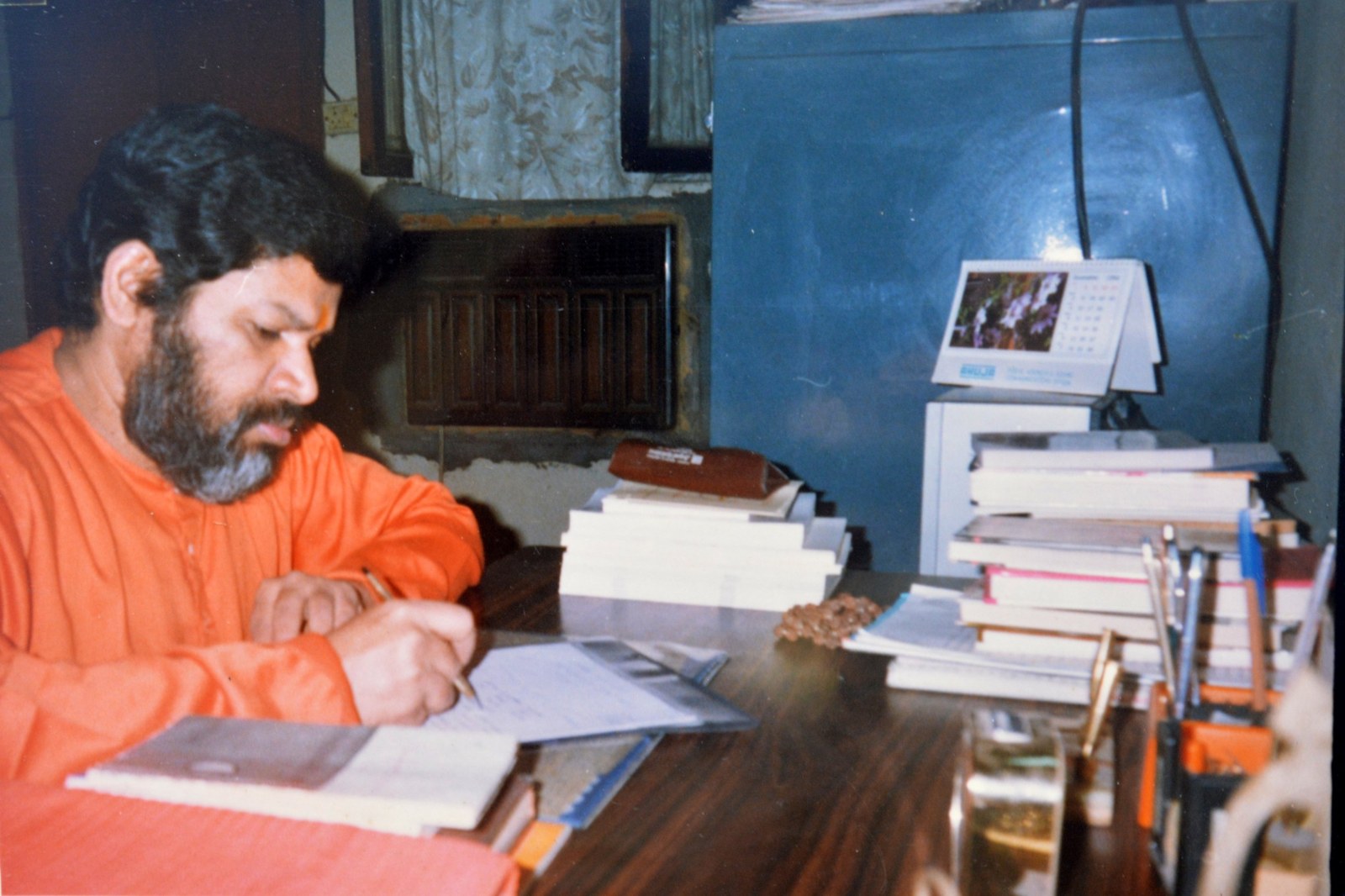
Swami Bodhananda writing at his desk, 1994, Sambodh, Defence Colony, New Delhi

The range of topics Swami Bodhananda addresses extends from human potential development, managerial excellence and leadership studies to the experience of “absolute peace in the midst of dynamic activity” — in papers and thoughts written on various occasions, travelogues, thematic notes, letters and discussions with devotees, public interviews and media reports, and messages on occasions of spiritual and cultural importance.

Read his messages and writings

The sacred footsteps

Footprints in the sand

The divine and spiritual presence of our Guru invokes an inner and self-giving motivation in us to come out of ruts and stereotypes, conflicts and dilemmas, and to experience the full flowering of the spirit.

To follow the sacred footsteps, the divya-pāda, of the Guru is to travel to the abode of the Ultimate Truth.

The Sambodh logo

The logo of Sambodh is made of three arcs and three birds: two trapped within and one flying out. The three arcs represent the three bodies — gross, subtle and causal — identifying with which infinite consciousness has become finite.

The two trapped birds stand for finite consciousness caught in samsara, the world of change, and for every kind of duality: seeker and sought, God and world, body and soul, good and bad, matter and spirit. The bird flying out into the infinite space of consciousness is the enlightened, integrated person who has resolved all duality and dis-identified with the three bodies and the three gunas.

The motto, uttiṣṭhata jāgrata nibodhata — arise, awake and realise — is from the Katha Upanishad: an exhortation to awake from material slumber through inquiry and discrimination.

Reflections & travelogues

2026Consciousness in the MachineVedāntins often confuse four entities — the ego self, conditioned intentional consciousness, witnessing consciousness and pure consciousness. If consciousness is in every manifestation and is every manifestation, could a machine become conscious? An Advaita reflection.Read →2026We Are a Network of I-sThere are three I-s — the body-mind ‘I’, the witness ‘I’ and the transcendental ‘I’ — and all are essentially the same Brahman. Like gold, a ring and a wedding ring, they are one stuff seen from different perspectives. Three I-s, one gold.Read →2026Where Does Happiness Come From?Behind our search for better machines and material abundance lies a more fundamental aspiration: the pursuit of happiness. Advaita distinguishes viṣaya sukham, happiness sought through objects, from ātma sukham, happiness discovered in the self.Read →2026Can We Build a Moral Machine?A machine may not need consciousness to act morally. It needs ethical direction, inclusive information and continuous learning — and the goal is a non-violent machine that can coexist and co-flourish with humanity.Read →2026History, Power and the Next Fifty YearsThe master–slave dynamic seems archetypal to human history. Geopolitics is static; power politics is dynamic. What Gurudev foresees, through Yoga Dṛṣṭi, for the next twenty-five years, from 2026 to 2051.Read →2026The Second Axial AgeThe source of the Second Axial Age will be the collective consciousness of global citizens — a networked and unified global self that feels and thinks for others. To exist is to globally coexist.Read →2026The Axial AgeKarl Jaspers’ “Axial Age” — a pivotal shift in human consciousness between the eighth and third centuries BCE. Its achievements have come with a cost: are human beings on the brink of extinction, and is it time to think of a second axial age?Read →2025Walking Back from the BrinkFrom the first fire and tools to industrial growth, humankind has tried to master nature. A reflection on why progress must now mean reconciliation with nature — to live with it rather than over it.Read →2024Limits of the Hindutva IdeologyThe 2024 parliamentary elections demonstrated the limits of the Hindutva ideology in holding on to power at the centre — a reading of India's electoral patterns, the idea of Akhanda Bharat, and the future of Indian democracy.Read →2020COVID-19 — Govindam Bhaja Mudhamate!The Coronavirus pandemic has awakened us all from our collective slumber. My initial reflections: I propose the philosophy of Don't-Worry-ism.Read →2015Thoughts about MotherMy mother was very dear to me, though I left her 45 years ago in search of God alone knows what… Gurudev's thoughts on the passing of his mother, 16 June 2015.Read →2014Modi, The New Prime MinisterNarendra Modi's stunning as well as sweeping victory in the general election to the 16th Parliament of India is epochal — thoughts on the day of his swearing-in.Read →2014Hinduism and Indian IdentityIndia's search for identity cannot be divorced from the 7000-year-long Hindu religious and cultural experience.Read →2012A Pilgrimage into the Future via the PastFour ideas are competing for India's soul — the Gandhian, the Hindutva, the Secularist and the Romantic. A journey through the heart of India: Sevagram, Paunar, Deeksha Bhumi, the RSS headquarters, Pune and Ralegan Siddhi.Read →2012The Yoga of ManagementManagement is the science of optimal utilization of material resources for human satisfaction. Yoga is the discipline of organizing human resources for individual fulfilment. Yoga and management are interchangeable words.Read →2011My Dear Friend Dr K G Nayar — A RequiemDr K G Nayar is no more. For the last fifteen years he was my good friend, partner and guide — a pragmatic visionary who thought in prose but acted poetically.Read →2011Ecstasy of the MysticSwami Bodhananda's keynote at the Life Positive Expo, India Habitat Centre, New Delhi, 26 March 2011 — as reported in Life Positive.Read →2011The Quintessential VedantinSwami Bodhananda has often been described as a cool, ‘cutting-edge’ swami… An interview on Vedanta, Indian management, karma yoga and the goal of human life.Read →2010Ramachar — An Archetype of Mystic LoveRamachar died! … He was a singing skylark, a symbol of eternal youth. Ramachar will live ever as an archetype of mystic love.Read →2010Then the Yak Fell into the RiverThe yak is a symbol of sturdiness, steadiness and nimble footedness… Memoirs of the Kailash–Manasarovar pilgrimage led by Sambodh Foundation in August 2010.Read →2009Hindu Dharma for the 21st CenturyThe first “Hindu Dharma for the 21st Century” seminar, at the Sambodh Centre for Human Excellence, Kalamazoo — deliberations on the salient features of Hindu Dharma and how to share them with Hindu youth growing up in the United States.Read →2009An Ode to RichardRichard is no more. But that is only physically. His memories live on… here was a man who lived his life fully, righteously and spiritually, and left the world richer than he found it.Read →2009Mahabharata and Indian ManagementA New Indian Renaissance is upon us. The purpose of this seminar is to develop a genuinely ‘Indian’ style of management, drawing on case studies from the Mahabharata.Read →2008Black Family in the White HouseAmericans are voting to elect the first Afro-American president. History has come full circle.Read →2008A Response to “Without God” by Steven WeinbergReligion is old science and science is new religion. The final test of spirituality is not certainty about Truth or God, but our willingness to talk with each other respectfully.Read →2007The China DiaryThe Dragon wants a makeover to the Panda image on the eve of the Beijing Olympics.Read →2007The Tiger is Thirty Years behind the DragonIndia is touted as a knowledge power and China as the muscle power of the world…Read →2007Whose Body Is It Anyway?King Shrutakirti of Avanti had a hundred wives but no son… A story of a grieving king, a sage, and a prince who has played the roles of sons and fathers in too many births to count.Read →2007Death Wish of the DeathlessAn old lady loses her only son to a snakebite. The hunter wants to punish the snake — but the snake blames Yama, Yama blames Time, and Time blames karma…Read →2007Who Cares?Brahmachari Visvabandhu meditates for years and returns again and again to report his realisations — and each time his Guru sends him back to the forest…Read →2007Drinking Water for Surya GaonDrinking water is the primary need of human beings. Thoughts after inaugurating the Sambodh drinking-water project at Surya Gaon village, Sattal, in Nainital district.Read →2005The Pope and the PresidentChristianity, Europe and America are three spaces that intersect to create the concept of the ‘West’ — group uniqueness, individual freedom and humanism.Read →2004Towards an Indian Management StyleManagement, a culturally determined discipline, exhibits flavours peculiar to the genius of the people. India has to integrate modern management values and practices with its age-old integral worldviews and human objectives.Read →2004On a Cross-country Drive in the US…from New York via Chicago to Kalamazoo, to deliver a talk at the Oshtemo Library.Read →2004Renunciation and the Call of DutyNehru considered the Prime Minister's post a duty he was called upon to perform; Indira and Rajiv Gandhi took it as their privilege. How should we classify Sonia Gandhi's renunciation — like Rama's, Buddha's or Bhishma's?Read →2003Hinduism and a Geopolitical Vision for IndiaIdeologies are empty unless you have the power to protect and expand them. What Hindus need is purposive action, not pious words.Read →2003On China's Attitude towards IndiaChina is ruthlessly pragmatic, self-centred and geopolitical in its strategies. India in my opinion is an unfinished work — a nation in the making.Read →2002Psychoanalysis and DeconstructionI believe in the free expression of ideas with good conscience, and in a spirit of fearless enquiry. Arrogance is good, but humility is better; teaching is a privilege, but learning is a better privilege.Read →2002Visit to an Amish CommunityWe visited a patriarch — carpenter-preacher, father of eleven and grandfather of sixty-seven.Read →2001Maha Kumbha MelaMy pilgrimage to the Maha Kumbha at Prayag was a soul-stirring experience.Read →1996Agenda for Self-RenewalGod and Human together create wealth, wellbeing and a just society. A focussed way to create wealth is the only way to self-renewal and the awakening of Kerala.Read →1996A Dialogue with EMS NamboodiripadThe questions Swami Bodhananda submitted to EMS Namboodiripad, EMS's written reply, and the transcript of their conversation of 2 February 1996.Read →1995The Pseudo-Debate over the Enron Power ProjectWhat lies at the heart of the debate on the cancellation of the Enron Dabhol Power Project? Only a market economy, directed by a democratic, secular polity, can lift 70 crore Indians out of poverty.Read →

Visit Swamiji's blog — Reflections & Travelogues

“If at all I have a mission, it is to laugh and laugh, and encourage a few others to laugh with me and ultimately seduce the whole creation to roar a cosmic laughter.”Swami Bodhananda · Guiding Vision

Thought for today

Seeing things as they are is freedom.

— Swami Bodhananda  ·  More reflections