
In an article I wrote (for a Springer Nature edited volume) on “Advaita Ethics for the Machine Age: The Pursuit of Happiness in an Interconnected World”, I explored how the insights of Advaita can contribute to contemporary discussions on artificial intelligence, ethics, consciousness, happiness and human flourishing.
I ask whether intelligent machines can be guided by values such as non-violence, restraint, inclusion and respect for the interconnectedness of life.
Over the next few weeks, I will discuss a few connected questions on these topics and invite you to reflect and discuss them with me.
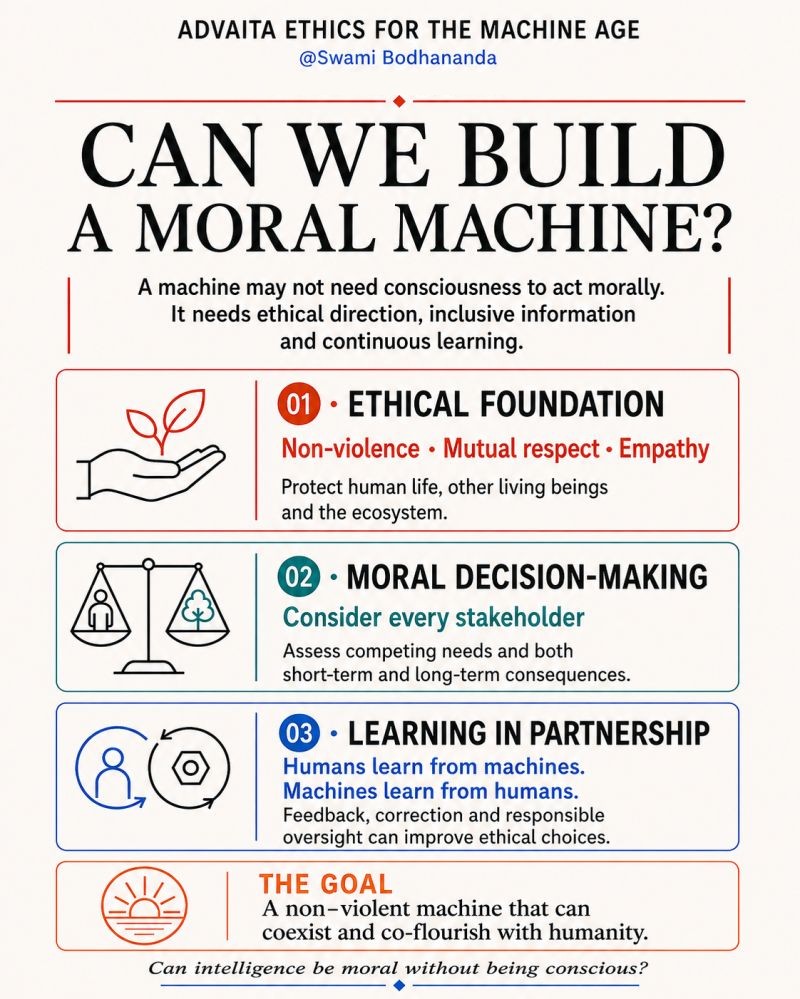
Artificial intelligence raises a fundamental question: “Can we build a machine that acts morally?”
When we speak of a moral machine, we often imagine a system that will not harm human beings, other living beings or the natural environment. We expect it to make rational choices, remain free from prejudice and consider both the immediate and long-term consequences of its actions.
But here we encounter a paradox. The model we offer the machine is the human being, and human beings themselves do not always act ethically. We may understand what is right and yet fail to choose it. In the Mahābhārata, Duryodhana admits that he knows what dharma is but is unable to follow it. This conflict between knowledge and action continues to shape human life.
I suggest that a machine may not need consciousness, selfhood or subjective experience in order to act morally. It may not have to “feel” compassion in the way a human being does. What it needs is ethical programming, reliable information and the capacity to consider the wellbeing of all those affected by its decisions.
A moral machine would collect information from different stakeholders, process competing needs and seek choices that contribute to collective wellbeing. Like human beings, it may initially be fallible. But it could learn through feedback, correction and continued interaction with society.
The aim should not be to produce a machine that imitates every aspect of the human personality. Rather, we should seek a non-violent machine that can coexist and co-flourish with humanity.
Human beings can learn from machines, and machines can learn from human beings. This reciprocal relationship may help us create a more ethical technological culture.
The real question, therefore, is not merely whether machines can become like us. It is whether human beings and machines can together become participants in a more responsible and compassionate world.
Let me know your thoughts.
Can intelligence be moral without being conscious?
Swami Bodhananda, 2 September 2026