
Contents
Continuity, discontinuity and the master–slave dynamic
It is difficult to delineate the boundaries of epochs. Continuity and discontinuity coexist in history, and each may subtly take the form of the other.
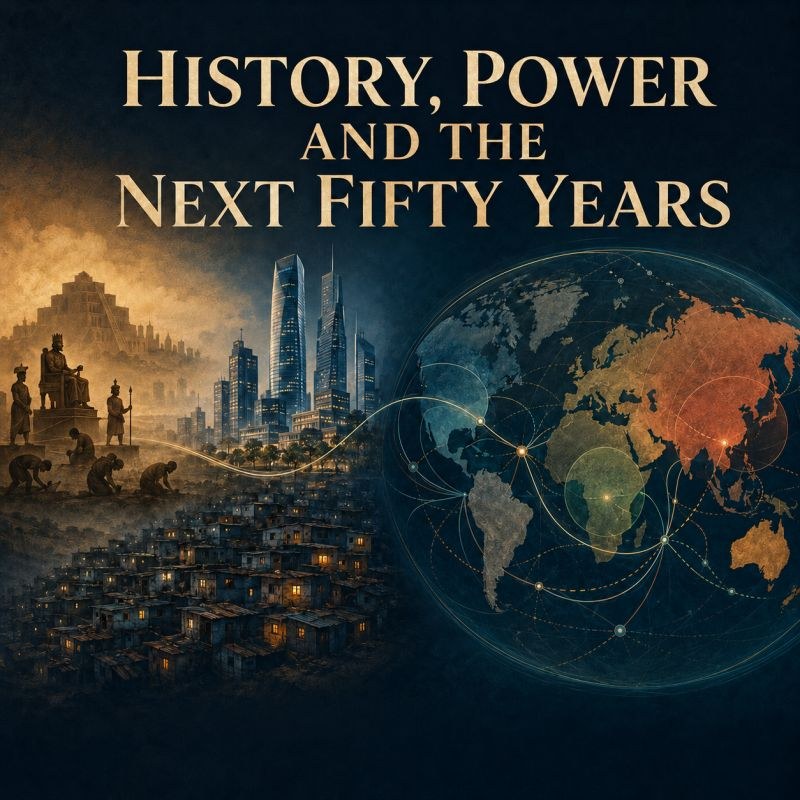
The master–slave dynamic seems archetypal to human history. It survives wherever control over scarce natural and human resources and decision-making is concentrated. The medicine man and client, tribal chieftain and subjects, serf and feudal lord, pope and flock, teacher and student, parent and child, capitalist and labourer reflect this pattern. Mumbai’s high-rise elites and slum-dwelling majority are products of the same template.
Geopolitics, power politics and the next twenty-five years
Geopolitics is static; power politics is dynamic. The former rests on geography, while the latter depends on military might, economic heft and technological superiority. The US and China are the principal superpowers. America’s remaining advantage is military, but China is fast closing the gap.
Middle powers such as India, Iran, Turkey and South Africa can resist superpower ambitions regionally and, together, disrupt tanker movements and supply chains. The Strait of Hormuz and India’s military presence near the Strait of Malacca illustrate this potential.
Europe and Russia may exhaust each other in Ukraine before entering a geostrategic partnership against resource-hungry China. Taiwan may find economic integration with China, if not political unification. North Korea will remain a scarecrow in China’s backyard, while Israel will remain a regional spoiler serving Western interests.
The Americas will struggle to escape the shadow of the US. Japan, Pakistan, Saudi Arabia, Egypt and Indonesia will exploit superpower rivalries and middle-power anxieties. South Asia will maintain a tenuous peace amid terrorism, nuclear threats and Chinese interventions.
African nations may dissipate their potential through internal rivalries and ethnic strife. Without a political centre or commanding vision, they risk becoming pawns in geopolitical and economic proxy wars.
Tech companies will increasingly rule the mindscape of scientists, theorists, policymakers and consumers.
This is what I foresee, through Yoga Dṛṣṭi, for the next twenty-five years, from 2026 to 2051.
Swami Bodhananda, 20 August 2026