
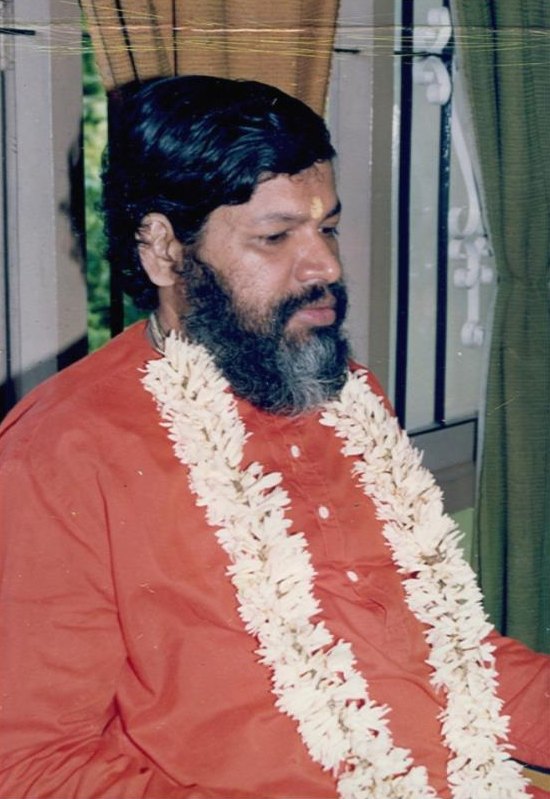
The following text is the set of questions submitted to EMS, from Swami Bodhananda, for discussion; and the transcript of the actual dialogue that took place between them on 2nd February, 1996 at 3.30pm. (This meeting was organized by BRF-ML.)
PART A: SUBMITTED QUESTIONNAIRE
1. What is the difference between consumerism and communism, since both aim to achieve mass consumption of more and more goods and services at lower and lower prices?
2. How do you compare the performance of capitalism, in the process of production, distributive justice, diversifying ownership of capital and decision making with that of the communist systems of erstwhile USSR, Cuba, Vietnam, China and North Korea.
3. Do you believe that India’s per capita income should be raised to Rs.10 lakh (US $ 25,000) per annum to ensure a dignified existence to all Indian citizens, comparable to world standards?
4. Should the computation of national wealth not take into consideration the invisible cost of development like ill health, violence, family disintegration and environmental degradation in our attempt to know the real wealth?
5. How do you understand the conflict between the Eastern family values and that of the Western individualistic values in the context of development?
6. Our foundation BRF-ML stands for creating awareness amongst people for an effective managerial and entrepreneurial culture to transform Malayalees from job seekers to job creators. Would you like to respond to this agenda of BRF-ML?
7. Educational institutions are there to create and disseminate knowledge; civil society and the state to maintain moral and social orders; industries are there to produce goods and services; and families to bring up caring and loving individual. Nothing should come in their way of fulfilling their foundational objectives. This calls for trust between teachers and students, leaders and citizens, employers and employees, and parents and children. How would you respond to a mass movement for the promotion of the above values?
8. We are planning to organize a ‘ritual’ to create a gut level trust between the workforce and management in ‘Gwalior Rayons’ at Mavoor. Would you extend your support to such an experiment?
9. How do you assess culture, spirituality and pluralism in unleashing hidden human potentialities?
10. What are the prospects of meditation and agitation in the emerging global village of convergence and divergence?
11. What makes man feel helpless and think of death and beyond death?
12. Can you look beyond Gandhism, Marxism, Capitalism and think of a global competitive Indian model of productive organization?
13. Do you think that liberal, democratic and market driven economy is the only workable model for a free and healthy society?
14. How do you understand the meaning of words like ‘soul’, ‘sacredness’, ‘freedom’, and do they represent some of your innermost feelings and thoughts?
15. What is the ultimate reference point in your thoughts and concerns—is it the individual or the group?
16. How do you understand materialism in the absence of ‘matter’ in modern physics—matter as something, which is fundamentally indivisible, objective and tangible?
Written responses of EMS sent through P. N.Subramanian to the questionnaire
Dear Mr.Subramanian,
I had told you when you where here that from your questions I got the impression that the differences between us are so deep that they cannot be resolved through dialogue. I do not want to spell out what are the differences because, if I tell you what I think you are thinking and doing, you may disclaim it. I would therefore clearly spell out my position.
1. I am a Marxist—Leninist and believe that humanity is now in the process of transition from capitalism to communism.
2. Transition from capitalism to communism will not be of the same type in all countries. For our country, it is a part by using parliamentary institutions (including governments in case we get a majority in elections) for preparing the people for the transition from capitalism to communism.
3. In this process India is today in a situation in which we have to fight the Narasimha Rao Govt.’s economic policies, the BJP’s communal policies and the support given by each of them to the other. That is why we are concentrating on the projection of a left and secular democratic combination in opposition to the Congress and the BJP.
4. This however is not a mere electoral combination but is supplemented by the coming together of the industrial and agricultural workers, working peasants, middle class employees and all other sections of the toiling people as well as those patriotic sections of the people who are interested in protecting the national sovereignty, unity and communal cohesion. Our activities on elctoral front has to be subordinated to the need for the creation of such an alternative. To this end we adopt appropriate tactical lines.
Yours Sincerely EMS Namboodiripad.
PART B: DIALOGUE BETWEEN PUJYA SWAMI BODHANANDA AND EMS NAMPOOTIRIPAD
SB: We had submitted a few questions. Would you kindly respond to them? (See Part A)
EMS: We will be talking at cross-purposes. I don’t think a dialogue between us is useful.
SB: Do we really differ? Our concerns are the same!
EMS: I am a Marxist. I cannot be anything other than that. I am a materialist. You are a spiritualist. You have a liking for capitalism. I am for socialism.
SB: We have no brief for capitalism.
EMS: Subjectively, you might be thinking that you are not a capitalist, but, objectively, you are a capitalist.
SB: But both systems like to increase wealth. The end objective of mass production is the same. Communism also has promoted consumerism.
EMS: Consumerism falls within the framework of capitalism.
SB: Can a worker increase his wealth without capital?
EMS: Workers cannot produce within the capitalist system. They can produce only if capitalism is abolished.
Swamiji: Capitalist economy itself abolished capitalism—concentration of exploitative capital.
EMS: World capitalism is exploiting us—all the third world countries.
SB: Is not capitalism itself evolving?
EMS: Capitalism is evolving more and more into an exploitative system.
SB: In USA there is more diverse control of capital.
EMS: In USA there is more and more monopoly capital, against which its people are fighting.
SB: What about the experience of the South East Asian countries which have removed poverty?
EMS: East Asian Countries are capitalists. The only country where poverty is reduced, but not eliminated, is China.
SB: China is capitalist, is it not?
EMS: No, I don’t think China is capitalist. Why should we continue this dialogue?
SB: Differences enhance the experience of creative synergy. The whole is more than the sum total of parts.
EMS: I don’t understand what is meant by ‘synergy’. These are technical terms which I don’t understand. I am an ordinary man. Again, I would like to say there is no use in continuing this dialogue.
SB: It will help us to initiate a dialogue amongst the youth. We respect you as a great leader who fought for the interest of poor people. But, how can we remove poverty? Can we learn anything from capitalist mode of development?
EMS: You cannot remove poverty within the framework of capitalism. Capitalist mode of production and distribution are anti-people.
SB: The framework of capitalism has integrated most of the aspirations of socialist states.
EMS: I totally disagree with you. What is the use of repeating the same thing again and again?
SB: What is the role of meditation and agitation in a world of convergence and divergence?
EMS: Firstly, I don’t believe in meditation. What is meditation?
SB: You do meditation! ‘Concentrated selfless work’—That is the definition of meditation. Meditation gives clarity to our thinking.
EMS: No.
SB: But, in the process we can find out areas of agreement and together could help the youth of this state.
EMS: I don’t know how! There is an ocean of difference between you and me. We can never agree with each other. Our approaches are totally different. What is the fun of finding agreement between two such men?
SB: Because of common concerns! And, nobody can work alone!
EMS: According to me nothing can be done. You seem to nurture the idea that a lot could be done within the framework of capitalism. I believe that nothing could be done as long as you support capitalism. What is the use of a dialogue between one who supports capitalism and one who fights against capitalism?
SB: This dialogue is only to initiate a discussion. I am thinking of capitalism objectively.
EMS: How can a sensible person compare communism with consumerism? The very poser is absurd.
SB: We are trying to understand various organizational techniques experimented at different parts of the world, to create our own responses to the problem of poverty.
EMS: You may do that! Don’t make me a partner in that!
SB: Don’t you feel that you have to help us since you have failed?
EMS: I don’t want to help you if you don’t want to help yourself. You should give up the idea that something could be done within the framework of capitalism. And, I don’t think that I have failed. I am going from success to success.
SB: The world sees you as the second greatest leader after Deng of China. Won’t you give us a leadership as Deng had given to the Chinese?
EMS: I don’t have the presumption that I am a great leader. There is no use in thinking in those lines.
SB: We sincerely request you to respond to the questionnaire submitted to you earlier. Be kind enough to give a written response. We want it; we deserve it and we welcome it!
Our profound thanks and respectful Pranams.